OpenAI DevDay 2023 | 5 Key Announcements and Future Directions
OpenAI DevDay (Nov-2023)

OpenAI DevDay, held on November 6, 2023, in San Francisco, marked a significant milestone in the journey of OpenAI, the world’s most advanced and widely used AI platform.
This inaugural developer Openai conference 2023 brought together hundreds of developers from around the globe to explore new tools, exchange ideas, and engage with the OpenAI team.
The OpenAI DevDay event showcased the latest advancements in AI technology, including the introduction of GPT-4 Turbo, a more capable model with a 128K context window and knowledge of world events up to April 2023. The conference also highlighted the launch of the Assistants API, enabling developers to build AI-powered assistants with the ability to call external APIs and functions.

The day was filled with exciting announcements, including the introduction of multimodal capabilities, new text-to-speech voices, and the upcoming Whisper v3 speech recognition model. OpenAI Dev Day served as a testament to OpenAI’s commitment to fostering an ecosystem of shared AI innovations and empowering developers to create groundbreaking applications
GPT-4 Turbo – A More Powerful AI Model

OpenAI unveiled GPT-4 Turbo, an upgraded version of GPT-4 that is more capable, cheaper, and supports a 128K context window, allowing it to take in the equivalent of over 300 pages of text at once. GPT-4 Turbo has been updated with world knowledge through April 2023.
The expanded context window allows it to follow conversations for much longer without losing context, and the updated knowledge cutoff means it can provide more current information in its responses.
The reduced pricing makes it more accessible to developers, with input tokens costing $0.01 per 1,000 tokens and output tokens costing $0.03 per 1,000 tokens.
Some key features of GPT-4 Turbo:
3x cheaper per token than GPT-4
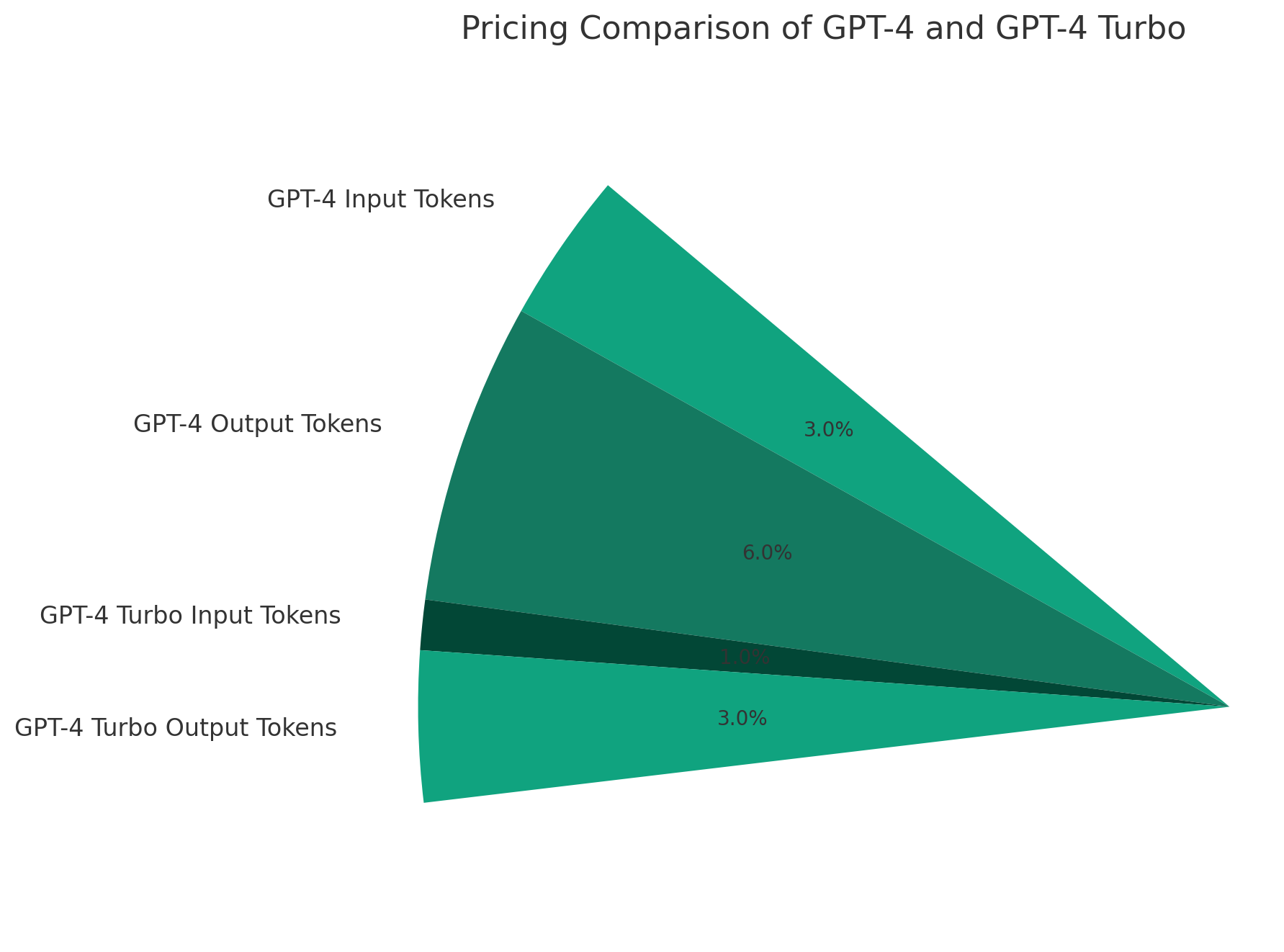
OpenAI’s GPT-4 Turbo is a more advanced version of its predecessor, GPT-4, and offers a significant cost advantage. The company has optimized the performance of GPT-4 Turbo, enabling it to offer the model at a 3x cheaper price for input tokens and a 2x cheaper price for output tokens compared to GPT-4.
Input tokens are the bits of raw text fed into the model, while output tokens are the tokens that the model generates based on the input tokens. For instance, the word “fantastic” might be split into “fan,” “tas,” and “tic” as tokens. The pricing for GPT-4 Turbo is set at $0.01 per 1,000 input tokens (~750 words) and $0.03 per 1,000 output tokens.
This cost reduction is a significant advantage for developers and companies using the model, as it allows them to run more information through the AI models at a lower cost. The cheaper pricing does not compromise the model’s capabilities. GPT-4 Turbo is more powerful, has an updated knowledge cutoff of April 2023, and introduces a 128k context window, which is the equivalent of 300 pages of text in a single prompt.
The cost advantage of GPT-4 Turbo over GPT-4 is part of OpenAI’s broader strategy to pass on savings to developers and make its AI models more accessible. This strategy is likely to stimulate more usage of the model, fostering innovation and development in various applications that leverage AI technology.
Multimodal capabilities including processing images and generating captions
GPT-4 Turbo introduces multimodal capabilities, allowing it to process images and generate captions. This feature enables the AI model to analyze images and provide relevant information or descriptions based on the visual content. This can be particularly useful for applications such as content creation, image analysis, and accessibility tools for visually impaired users
Higher quality and more relevant responses
GPT-4 Turbo offers higher quality and more relevant responses compared to its predecessor, GPT-4. The updated model has an expanded context window of 128K tokens, allowing it to process and understand more information at once. This results in more accurate and coherent responses, making it a more powerful tool for various applications, such as customer service, content generation, and data analysis.
Coming soon to the API for developers
GPT-4 Turbo is currently available in preview for developers through the OpenAI API, and the stable production-ready model is planned to be released in the coming weeks. This will enable developers to integrate GPT-4 Turbo into their applications and services, taking advantage of its improved capabilities and reduced pricing.
GPT-4 Turbo represents a major advancement in large language models. The expanded context window allows it to follow conversations for much longer without losing context. The updated knowledge cutoff means it can provide more current information in its responses. And the reduced pricing makes it more accessible to developers.
Assistants API for Building AI Agents
OpenAI launched a new Assistants API that makes it easier for developers to build their own AI-powered assistants. Key features include persistent, infinite length conversations to mimic natural back-and-forth dialog, the ability for assistants to call APIs and external functions, and tools for assistants to retrieve knowledge, take actions, and more.
This API opens up new possibilities for developers to create intelligent assistants tailored to specific use cases, such as booking travel, answering customer service queries, or assisting with coding and data analysis.
Key features include:
Persistent, infinite length conversations to mimic natural back-and-forth dialog
The Assistants API, launched by OpenAI, enables developers to build AI-powered assistants that can engage in persistent, infinite length conversations. This feature allows the AI to mimic natural back-and-forth dialog, providing a more engaging and human-like interaction experience.
The ability for assistants to call APIs and external functions
The Assistants API also provides the ability for AI assistants to call external APIs and functions. This enables the AI to access external data sources, perform specific tasks, and interact with other services, making it a more versatile and powerful tool for developers.
Tools for assistants to retrieve knowledge, take actions, and more
The Assistants API offers various tools for AI assistants to retrieve knowledge, take actions, and perform other tasks. This allows developers to create intelligent assistants tailored to specific use cases, such as booking travel, answering customer service queries, or assisting with coding and data analysis
Currently in beta but available to all developers
The Assistants API is currently in beta but is available to all developers. This provides an opportunity for developers to experiment with the API, build their AI-powered assistants, and provide feedback to OpenAI for further improvements.
This API opens up new possibilities for developers to create intelligent assistants tailored to specific use cases. For example, assistants can book travel, answer customer service queries, or even assist with coding and data analysis.
GPT Store for Sharing AI Models
OpenAI announced a new GPT store, coming later this month, where developers can publish AI bots they have built using tools like the GPT Builder. The store will enable the community to easily discover, share, and even monetize AI models.
Verified builders can publish their GPT creations, users can browse and interact with shared models, and revenue sharing will be available for popular or useful models. The GPT Store fosters an ecosystem of shared AI innovations.
The store will enable the community to easily discover, share, and even monetize AI models.
Verified builders can publish their GPT creations
With the upcoming GPT Store, verified builders will be able to publish their GPT creations, allowing the community to discover, share, and monetize AI models
Users can browse and interact with shared models
The GPT Store will enable users to browse and interact with shared models, providing a platform for users to explore and utilize various AI models created by the community.
Revenue sharing for popular/useful models
OpenAI plans to implement a revenue-sharing model for popular and useful GPT creations, incentivizing developers to create high-quality AI models and fostering an ecosystem of shared AI innovations.
Fosters an ecosystem of shared AI innovations
The GPT Store aims to foster an ecosystem of shared AI innovations, encouraging collaboration and the exchange of ideas among developers. This will help drive the development of new AI applications and solutions, benefiting the entire community.
The GPT Store provides a marketplace for custom AI while rewarding creators, allowing for collaborative innovation.
Expanded Capabilities for Vision, Speech, and More
Other announcements aimed to improve OpenAI products with more modalities. GPT-4 Turbo can now process images for vision capabilities, and it supports text-to-speech requests with DALL-E 3 integration. New text-to-speech voices and an audio API have also been introduced. These advancements show OpenAI’s commitment to advancing multimodal AI that can see, speak, and more.
Other announcements aimed to improve OpenAI products with more modalities:
DALL-E 3 API is now available to generate images programmatically
OpenAI has made the DALL-E 3 API available, allowing developers to generate images programmatically. This can be useful for applications such as content creation, design, and visualization.
GPT-4 Turbo can now process images for vision capabilities
GPT-4 Turbo has been updated to process images, enabling it to provide vision capabilities. This feature can be used for applications such as generating captions, analyzing images in detail, and reading documents with figures.
New text-to-speech voices and audio API
OpenAI has introduced new text-to-speech voices and an audio API in this DevDay Event, allowing developers to generate natural-sounding audio outputs with multiple voice presets. This can enhance accessibility and enable use cases such as language learning and voice assistants.
Whisper v3 speech recognition model coming soon
OpenAI has announced that the Whisper v3 speech recognition model will be coming soon. This will further expand the capabilities of OpenAI’s platform, enabling it to understand and process spoken language, and opening up new possibilities for voice-based applications.
Together these show OpenAI’s commitment to advancing multimodal AI that can see, speak, and more.
Copyright Shield
in devday 2023 what is gpt4 latest copyright shield. write a short 300 words of content about it. with 1 introduction paragraph and bullet points.
Here is a 300 word summary of key information about GPT-4’s latest Copyright Shield from OpenAI:
At their inaugural developer conference DevDay 2023, OpenAI announced a new legal protection called Copyright Shield for customers using their AI systems like GPT-4. This shields customers from potential copyright lawsuits over content generated by OpenAI’s systems.
What is Copyright Shield?
- Copyright Shield defends customers and covers legal costs if they face copyright lawsuits over GPT-4’s outputs.
- It applies to ChatGPT Enterprise customers and API platform users.
- OpenAI will never train its models on customer data from Enterprise or the API.
- Copyright Shield shows OpenAI’s commitment to protecting customers as AI generative abilities create new legal gray areas.
Details
- Covers costs incurred from legal claims or copyright lawsuits over GPT-4 content.
- Meant to give customers confidence in using GPT-4 capabilities without legal risks.
- Complements OpenAI’s other efforts like content filtering and human oversight to prevent harmful content.
- Comes alongside the launch of GPT-4 Turbo, the latest version of GPT-4.
Significance
- Addresses growing legal and ethical concerns around AI content creation.
- Differentiates OpenAI from other vendors lacking such protections.
- Encourages responsible use of OpenAI models by enterprise customers.
- Allows developers to innovate with GPT-4 without legal fears.
Copyright Shield indicates OpenAI’s leadership in supporting customers with AI safety measures amidst the rapid growth of generative AI. It’s a key step to promote ethical and beneficial use of powerful models like GPT-4.
OpenAI conference 2023 (OpenAI DevDay) Video
More to Come
The OpenAI Dev Day keynote showed impressive progress across OpenAI’s platform. With new models, APIs, and capabilities launched, it’s clear there is much more innovation still to come. The event kicked off what is sure to be an exciting time in AI development.